By Jenny Holly Hansen | Langley News | April 9, 2026

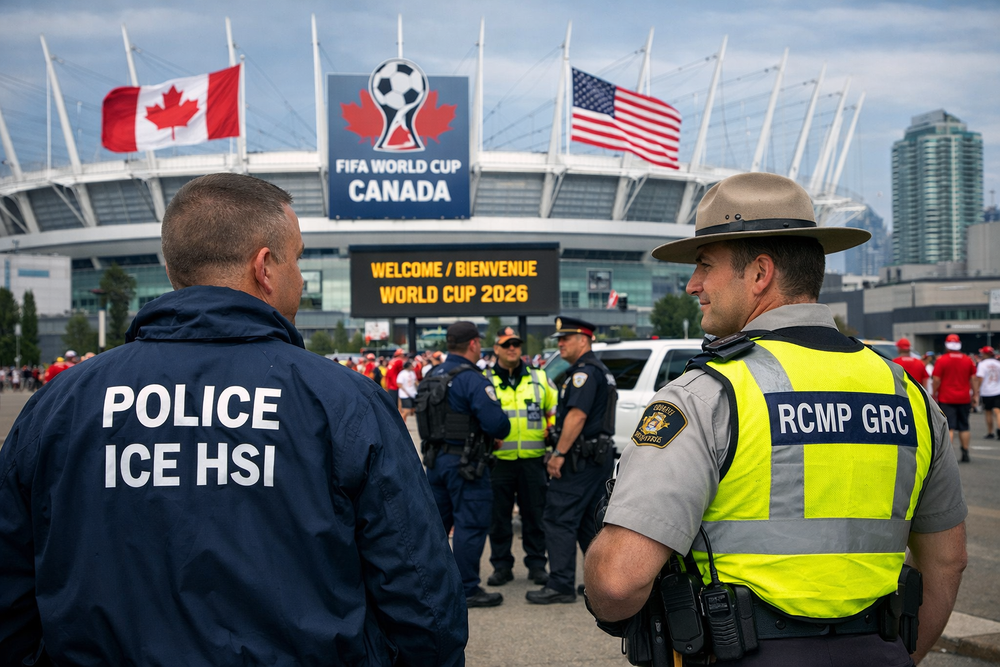
As Canada prepares to host matches for the 2026 FIFA World Cup alongside the United States and Mexico, questions have begun to surface around security—particularly regarding the role of U.S. Immigration and Customs Enforcement (ICE). For many, the idea of ICE operating in Canada raises immediate concern. However, the reality is more nuanced, and far less alarming than some headlines suggest.

The 2026 World Cup will be one of the largest sporting events in history, spanning three countries and drawing millions of fans across international borders. With that scale comes complexity. Security planning extends well beyond stadiums and crowds; it includes monitoring transnational risks such as human trafficking, organized crime, cross-border smuggling, and potential large-scale threats. This is where ICE, specifically its investigative branch Homeland Security Investigations (HSI), plays a role. HSI specializes in transnational crime, and for global events like the World Cup, its primary function is to share intelligence and coordinate with international partners. This type of collaboration is not new—it is standard practice at events such as the Olympics and the Super Bowl.

ICE personnel will be present in Canada during the World Cup, but their role is limited and clearly defined. They will work alongside Canadian law enforcement agencies, including the RCMP and local police, to share information related to cross-border threats and support investigations involving international criminal networks. In practical terms, they act as liaison officers, helping ensure communication and coordination between countries remains seamless.

Equally important is what ICE will not be doing in Canada. ICE agents do not have law enforcement authority on Canadian soil. They will not conduct arrests, enforce immigration laws, or carry firearms, and they cannot operate independently of Canadian agencies. Canadian officials have been clear that all enforcement authority remains with Canadian law enforcement. Any policing, public safety response, or interaction with residents and visitors will be handled entirely by Canadian authorities.

Despite these limitations, public concern is understandable. ICE has a controversial reputation in the United States, particularly in relation to immigration enforcement, and for some, its presence—however limited—raises concerns about how visitors and communities might be affected. In cities such as Toronto and Vancouver, this has sparked public discussion and some political pushback, largely rooted in a desire to ensure the World Cup remains welcoming and inclusive. There is also a communication gap at play; when people hear that “ICE is coming to Canada,” it can easily be interpreted as enforcement crossing the border, which is not the case.

The simplest way to understand the situation is to recognize the difference in roles across borders. In the United States, ICE operates with full authority. In Canada, it functions strictly as a supporting partner focused on intelligence sharing and coordination. For an event of this scale, spanning multiple countries, this level of cooperation is not unusual—it is essential.

Ultimately, the 2026 World Cup represents more than just a global sporting event. It is also a demonstration of how countries can work together to manage complex logistical and security challenges while respecting each other’s legal boundaries. In Canada’s case, that boundary remains clear: security and enforcement stay firmly in Canadian hands.


Sources

U.S. Immigration and Customs Enforcement (ICE) statements on World Cup security coordination; Homeland Security Investigations (HSI) event security role summaries; Canadian government and law enforcement briefings (including RCMP and municipal statements); VisaHQ News (April 2026) reporting that ICE agents in Canada will be unarmed during World Cup collaboration; CJME News (April 2026) confirming ICE has no enforcement authority in Canada; and The Digest (2026) outlining ICE’s role in international event security.

Let’s Keep Talking:

Jenny Holly Hansen, Business Insurance Broker since 2006

Email: hello@jennyhollyhansen.ca

Phone: 604-317-6755

LinkedIn https://www.linkedin.com/in/jenny-holly-hansen-365b691b/.  

TAGS:  #Jenny Holly Hansen #Protect Your Business #Community Impact #Langley Connect #Surrey Connect #Connect Network #2026 FIFA World Cup #USA Immigration and Customs Enforcement (ICE)

Share this article
The link has been copied!