✍️ By Debbie Balfour | Langley News | July 1, 2026 | Click HERE for your FREE Subscription to Langley News and/or to be a Contributor.

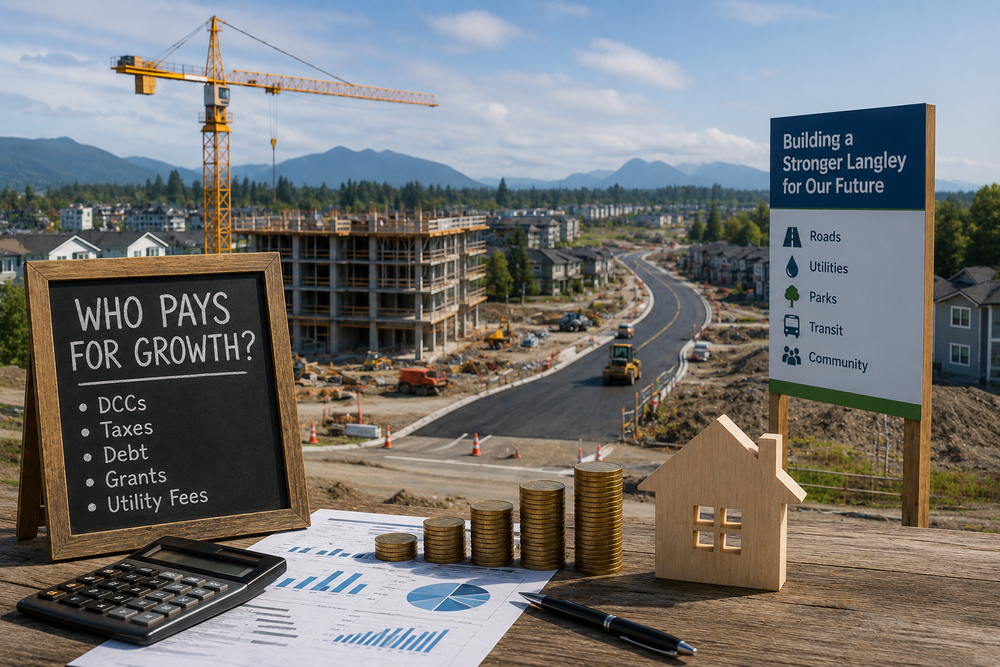
New roads, utilities, parks, transit investments, and community amenities are often celebrated as signs of progress. But behind every project is a harder question many residents rarely ask: who pays for it?

As Langley continues to grow, infrastructure costs are becoming one of the community’s most important financial debates. Growth requires roads, water, sewer, drainage, parks, and public services, but those investments are rarely funded from one source alone.

In British Columbia, Development Cost Charges, or DCCs, are collected from new development to help pay for infrastructure needed to service growth. The Township of Langley says DCCs help offset costs for highways, drainage, sewage, water, and park facilities tied to new development. The Province also confirms local governments and TransLink use DCCs to fund new or expanded infrastructure required by development.

But DCCs are only part of the picture. Infrastructure is also funded through municipal borrowing, provincial and federal grants, utility fees, reserves, and property taxes. Langley Township approved a 3.97% property tax increase for 2026, showing how local taxation remains part of the broader infrastructure conversation.

Growth Should Pay for Growth

Developers and growth advocates often argue that new development should help fund the infrastructure it requires. They point to DCCs as a practical tool that allows municipalities to collect money upfront as housing, commercial, and industrial projects move forward.

They also argue growth brings benefits: new homes, jobs, business investment, expanded tax base, and stronger local services. Without infrastructure expansion, they say, Langley cannot realistically accommodate the population growth already underway.

Taxpayers Are Asking Hard Questions

Residents see the issue differently. Many worry that even when developers pay DCCs, infrastructure costs eventually show up through higher home prices, property taxes, utility fees, or long-term municipal debt.

Some question whether today’s decisions could leave future taxpayers paying for decades of maintenance and replacement. Others ask whether growth is being managed carefully enough, or whether infrastructure is constantly trying to catch up.

The Complicated Reality

The truth is that both sides have a point.

Infrastructure investments can improve quality of life through better transportation networks, reliable water and sewer systems, parks, recreation spaces, and economic activity. But every new asset also creates future obligations. Roads must be repaved. Pipes must be replaced. Parks must be maintained.

Langley’s challenge is not simply building for growth. It is paying for growth responsibly.

Infrastructure investment is essential, but understanding how it is funded is equally important.

As Langley continues to expand, can the community balance growth, affordability, and infrastructure needs without placing an unsustainable burden on future generations?


Debbie Balfour | Real Estate Investing Success Coach + Podcast Host
📍 Website: www.DebbieBalfour.com
📧 Email: Debbie@DebbieBalfour.com
🔗 LinkedIn: Debbie Balfour
▶️ YouTube Channel: youtube.com/@DebbieBalfour

Join the FREE Facebook Group: Real Estate Investor Success Hub

Download your FREE 7 Proven Ways To Invest In Real Estate Without Using Your Own Cash guide.

TAGS: #Langley Infrastructure #Property Taxes #Real Estate Investing #Growth Pays For Growth #Fraser Valley #Langley News #Debbie Balfour

Share this article
The link has been copied!