
Road Widening in Langley Solving Congestion or Creating More Traffic?
Langley's road widening projects aim to reduce congestion and support growth, but critics question whether expanding roads ultimately creates more traffic and environmental costs.

Langley's road widening projects aim to reduce congestion and support growth, but critics question whether expanding roads ultimately creates more traffic and environmental costs.
✍️ By Debbie Balfour | Langley News | June 24, 2026
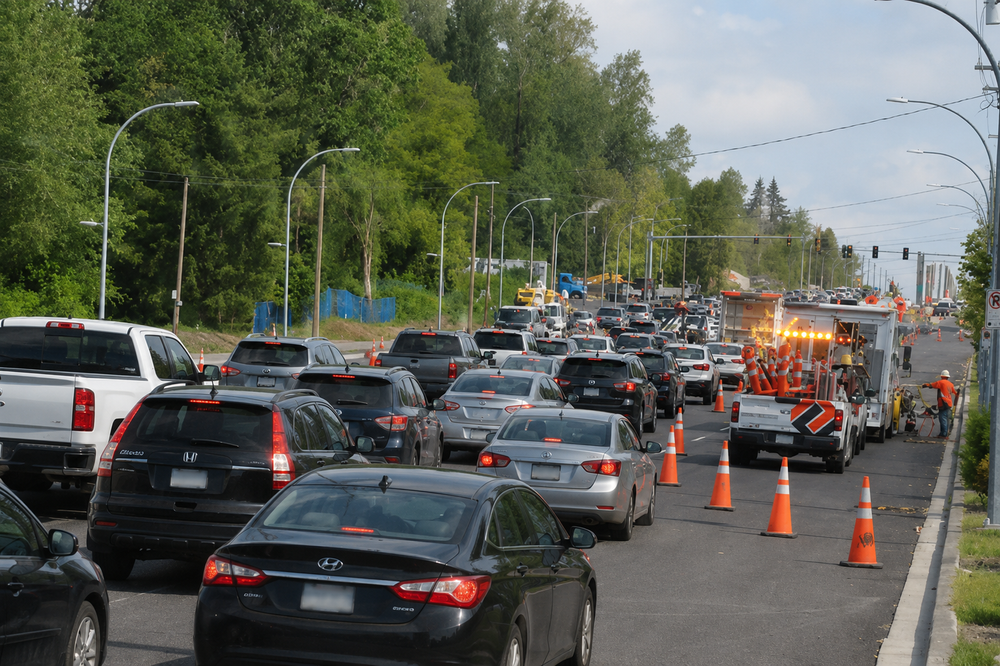
It's 5:15 p.m. on a weekday. You're inching along 208 Street. The light changes twice before you make it through the intersection. A delivery truck is trying to turn left. Commuters are pouring out of new subdivisions. Frustration builds as you glance at the clock.
For many Langley residents, this scene feels increasingly familiar.
To address growing congestion, Langley has invested heavily in road improvements, including upgrades to 208 Street, 80 Avenue, 86 Avenue, Fraser Highway, and numerous major intersections. At the same time, governments are investing nearly $6 billion in the Surrey-Langley SkyTrain extension, one of the largest transit projects in British Columbia's history.
The question is becoming harder to ignore: if traffic congestion continues to worsen, are wider roads really the answer?
Few would dispute that Langley is growing rapidly.
Population growth throughout the Township and City of Langley has accelerated over the past two decades. New housing developments continue to emerge, industrial lands are expanding, and commercial activity is increasing throughout the region.
Municipal planners often point to several reasons for road expansion:
• Population growth and new housing
• Increased commercial and industrial activity
• Truck and freight movement
• Emergency vehicle access
• Existing traffic bottlenecks
• Regional transportation connectivity
Supporters argue these projects are not luxuries but necessities.
Business owners depend on reliable transportation networks. Developers argue that infrastructure must keep pace with housing demand. Emergency responders require efficient routes during peak traffic periods. Residents simply want to spend less time sitting in traffic.
For many, widening roads appears to be common sense.
If more people are using the transportation network, shouldn't the network become larger?
Proponents of road expansion point to tangible benefits.
Additional lanes can reduce bottlenecks at key locations. Improved intersections can enhance safety by reducing conflict points and improving traffic flow. Freight movement becomes more efficient, helping businesses reduce transportation costs.
Supporters also argue that transportation infrastructure is essential for economic growth.
Companies considering investments often evaluate transportation access. Industrial developments rely on truck access. Retail centres depend on customer accessibility.
Many residents who drive daily see road widening as a practical response to reality.
After all, despite investments in transit, most trips in Langley are still made by automobile.
Can a fast-growing suburban community realistically function without expanding road capacity?
Supporters believe the answer is no.
This is where the debate becomes more complicated.
Transportation researchers often point to a concept known as induced demand.
The theory suggests that when road capacity increases, additional drivers eventually begin using the expanded roadway. Some people change travel routes. Others choose to drive at different times. New development may occur because improved roads make certain areas more accessible.
As a result, congestion that initially improves can gradually return.
Researchers studying highway expansions throughout North America have repeatedly found that increased capacity often attracts additional traffic over time.
Critics argue that road widening can become a cycle:
This does not mean road projects never help. Many transportation experts acknowledge that targeted intersection improvements and bottleneck removal can provide meaningful benefits.
However, critics question whether major widening projects deliver the long-term congestion relief that taxpayers expect.
If traffic eventually returns, are taxpayers receiving good value for their investment?
Environmental concerns add another dimension to the discussion.
Road expansions can encourage additional vehicle travel, which may increase transportation-related greenhouse gas emissions.
Critics also point to:
• Loss of green space
• Habitat disruption
• Increased stormwater runoff
• Greater paved surface areas
• Potential conflicts with climate objectives
Some environmental advocates argue that every dollar spent expanding roads is a dollar not spent on public transit, cycling infrastructure, or pedestrian improvements.
They contend that expanding roads reinforces automobile dependence rather than reducing it.
Supporters counter that people will continue driving regardless of policy goals and that safer, more efficient roads can reduce idling and improve traffic flow.
The environmental debate remains far from settled.
At first glance, the strategy appears contradictory.
Governments are investing billions in the Surrey-Langley SkyTrain extension while simultaneously funding road expansions and intersection upgrades.
Why pursue both?
The answer may lie in how Langley developed.
Unlike dense urban centres, much of Langley was built around automobile travel. Residential neighbourhoods, industrial parks, agricultural areas, and commercial centres are spread across a large geographic area.
Even with expanded transit, many residents will likely continue relying on vehicles for years to come.
At the same time, planners recognize that future growth may be impossible to accommodate through road expansion alone.
As a result, governments are pursuing a hybrid strategy:
• Expand transit options
• Improve cycling and pedestrian infrastructure
• Upgrade key roads and intersections
• Support long-term population growth
Whether this balanced approach succeeds remains one of Langley's most important planning questions.
Transportation infrastructure has always influenced real estate values.
Properties with improved accessibility often become more attractive to buyers and businesses. Commercial corridors can experience increased investment when transportation networks improve.
Road upgrades may create new development opportunities and improve access to employment centres.
However, infrastructure investments also come with costs.
Major projects require ongoing maintenance, long-term funding commitments, and in some cases increased municipal expenditures. Property owners ultimately share these costs through taxation and utility fees.
For investors, homeowners, and businesses, transportation planning is more than a traffic issue; it is a real estate issue.
As Langley grows, property owners, investors, and business owners often face questions about contracts, property rights, development, and municipal regulations. Having access to affordable legal guidance can help you make informed decisions before issues become costly problems.
Learn how LegalShield can help protect your family, business, and investments as our community continues to evolve.
Perhaps the most important question has little to do with traffic.
What kind of community does Langley want to become over the next 20 years?
One vision emphasizes road-focused growth, where transportation planning continues to prioritize automobiles and road capacity.
Another emphasizes transit-focused growth, where higher-density communities are built around public transportation and walkable neighbourhoods.
Neither vision is entirely right or entirely wrong.
Most residents likely want elements of both.
The challenge for decision-makers is determining the right balance between mobility, affordability, environmental responsibility, economic growth, and quality of life.
The debate over road widening in Langley is unlikely to end anytime soon.
Supporters raise compelling arguments about growth, safety, commerce, and practicality. Critics raise equally important concerns about induced demand, environmental impacts, and long-term sustainability.
Both sides bring valid evidence to the table.
The real question may not be whether Langley should invest in roads or transit.
It may be how much investment should go toward each.
As construction continues and the region grows, residents will ultimately decide what kind of transportation future they want.
Is road widening a necessary investment in a growing community, or an expensive solution that eventually creates more traffic than it solves?
Debbie Balfour | Real Estate Investing Success Coach + Podcast Host
📍 Website: www.DebbieBalfour.com
📧 Email: Debbie@DebbieBalfour.com
🔗 LinkedIn: Debbie Balfour
▶️ YouTube Channel: youtube.com/@DebbieBalfour
Join the FREE Facebook Group: Real Estate Investor Success Hub
Download your FREE 7 Proven Ways To Invest In Real Estate Without Using Your Own Cash guide.
TAGS: #Langley Infrastructure #Road Widening #Transportation Planning #Langley Growth #Real Estate #Langley News #Debbie Balfour