By Jenny Holly Hansen | Langley News | April 21, 2026

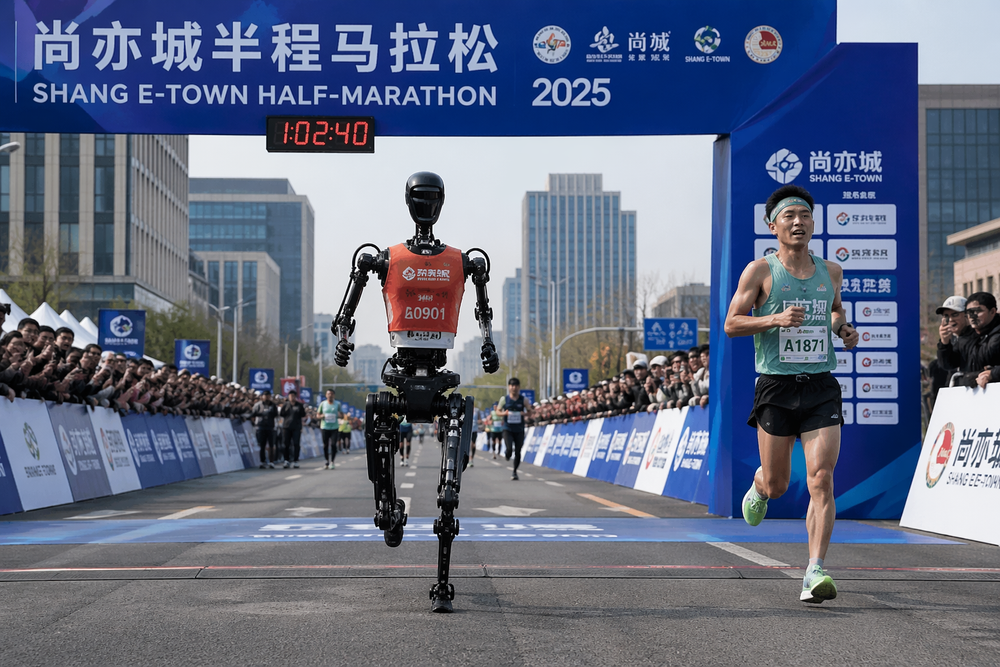
At a recent half-marathon event in Asia, humanoid robots didn’t just participate alongside humans—they dominated the race. In a result that feels almost pulled from science fiction, robots claimed the top three finishing positions and, even more strikingly, surpassed the human world record by nearly seven minutes.

Just a year earlier, the idea would have sounded unrealistic. In 2025, the fastest robots were still struggling to complete long-distance races, finishing well behind even amateur human runners. But the pace of advancement has been staggering. By 2026, improvements in artificial intelligence, balance systems, and energy efficiency transformed these machines from experimental prototypes into highly optimized endurance runners.

The winning robot completed the half-marathon in just over 50 minutes—a time that doesn’t just compete with elite human performance, but decisively beats it. For context, the human world record for the half-marathon sits at just over 57 minutes. Closing that gap would have been impressive. Surpassing it by such a margin signals something far more significant: machines are no longer just catching up—they are beginning to exceed us in specific physical domains.

What makes this possible is perfectly calibrated pacing, consistent stride mechanics, and systems designed to manage heat and energy use with remarkable efficiency. Where human runners must constantly adapt to their limits, robots operate without hesitation, maintaining optimal performance from start to finish.

That said, the race wasn’t flawless for every machine. Some robots stumbled, lost balance, or required assistance mid-course, a reminder that the technology is still evolving. The winners may have looked seamless, but the broader field showed that we are still in the early stages of this transition—something closer to the early days of motorsport than a fully mature competition.

Still, the implications are hard to ignore. It marked a clear turning point: the moment machines surpassed humans in a long-distance running event under real-world conditions. And with that comes a shift in how we think about performance, competition, and even identity in sport.

Yet, in an interesting way, this doesn’t diminish human achievement—it reframes it. Humans don’t run with perfect efficiency. We run through fatigue, uncertainty, and effort. We adjust, struggle, and push beyond limits in ways that aren’t easily replicated by code or mechanics. If anything, the contrast may make human performance feel more meaningful, not less.

For now, robots may have taken the podium. But the real story isn’t just about who won the race—it’s about how quickly the landscape is changing. A year ago, these machines were trying to finish. Today, they’re setting records. And looking ahead, it’s becoming clear that this isn’t the end of the race between humans and machines—it’s just the beginning.

Let’s Keep Talking:

Jenny Holly Hansen, Business Insurance Broker since 2006

Email: hello@jennyhollyhansen.ca

Phone: 604-317-6755

LinkedIn https://www.linkedin.com/in/jenny-holly-hansen-365b691b/.  

TAGS:  #Jenny Holly Hansen #Protect Your Business #Community Impact #Langley Connect #Surrey Connect #Connect Network #Robots #Artificial Intelligence (AI) #Half Marathon

Share this article
The link has been copied!