Karalee Greer | Langley City News | October 5 - 11, 2026
Subscription and being a Contributor to Langley City News is
Free

Editor's Note: “On This Week” features the strongest verified historical events connected to each calendar week. Historical significance takes priority over including every region equally.

From democracy and independence to music and space exploration, October 5–11 contains moments that changed politics, culture, and our understanding of the world beyond Earth.

History Around The World

The Americas

October 5, 1947 — Television Enters The White House

President Harry S. Truman delivered the first televised presidential address from the White House, asking Americans to conserve food to help postwar Europe.

Few households owned televisions, but the broadcast foreshadowed how television—and eventually digital media—would transform political communication.

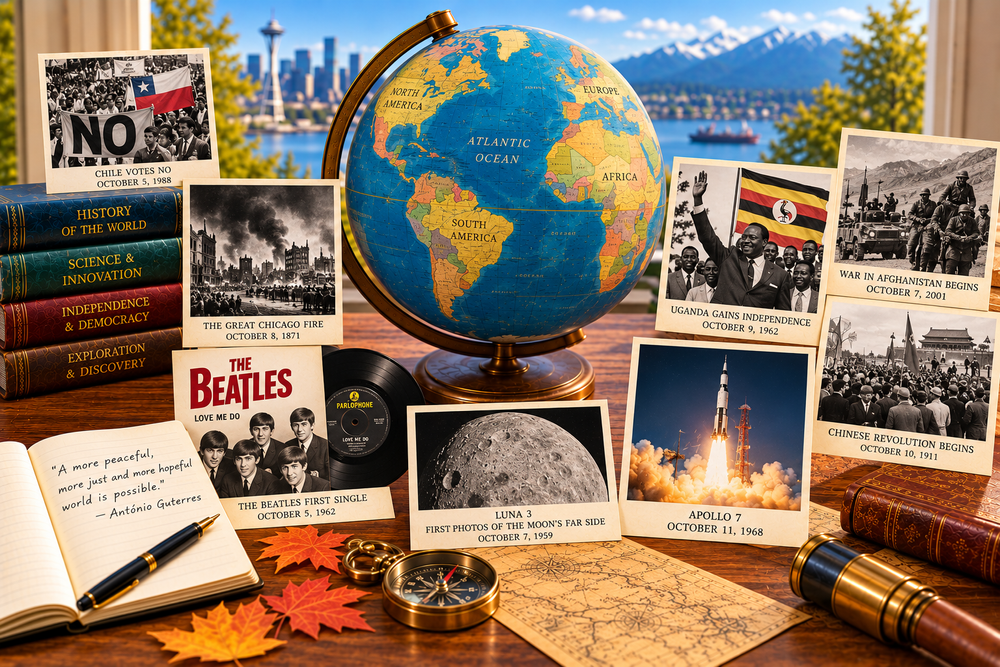
October 5, 1988 — Chile Votes Against Military Rule

Chileans voted on whether General Augusto Pinochet should remain president for another eight years. The opposition's “No” campaign won about 55% of valid votes, opening the way to democratic elections.

The referendum became a powerful example of citizens using the ballot box to help move a country away from dictatorship.

October 8, 1871 — The Great Chicago Fire Begins

The Great Chicago Fire destroyed more than 17,000 structures, left roughly 100,000 people homeless, and killed about 300.

Chicago's rebuilding encouraged improvements in construction, fire protection, architecture, and urban planning that influenced cities far beyond Chicago.

Europe

October 5, 1962 — The Beatles Release Their First Single

The Beatles released Love Me Do in Britain, beginning one of the most influential careers in popular music.

The Liverpool band would transform songwriting, recording, fashion, youth culture, and popular music around the world.

Asia & The Middle East

October 6, 1973 — The Yom Kippur War Begins

Egypt and Syria launched coordinated attacks against Israeli forces, beginning the Yom Kippur War.

The conflict drew Cold War powers into the crisis and contributed to an oil embargo and soaring energy prices. Its diplomatic aftermath eventually helped lead to the Egyptian-Israeli peace process.

October 7, 2001 — The War In Afghanistan Begins

The United States and Britain began military operations in Afghanistan following the September 11 terrorist attacks.

What began as an effort to dismantle al-Qaeda and remove the Taliban government developed into a 20-year war involving international forces, including Canada. The Taliban returned to power in 2021.

October 7, 2026, marks 25 years since the war began.

October 10, 1911 — The Chinese Revolution Begins

An uprising in Wuchang triggered the 1911 Chinese Revolution, leading to the collapse of the Qing dynasty.

The last Qing emperor abdicated in 1912, ending more than two thousand years of imperial rule and beginning a turbulent new political era in China.

Africa

October 9, 1962 — Uganda Gains Independence

Uganda gained independence from Britain, with Milton Obote becoming its first prime minister.

The milestone was part of the wider wave of African decolonization that transformed the continent during the 1950s and 1960s. October 9 remains Uganda's Independence Day.

Science & Technology Watch

October 7, 1959 — Humanity Sees The Far Side Of The Moon

The Soviet spacecraft Luna 3 captured the first photographs of the Moon's far side, revealing terrain humans had never seen before.

The images were grainy, but scientifically groundbreaking. They showed that the far side was much more heavily cratered and had fewer large dark plains than the side visible from Earth.

October 11, 1968 — Apollo 7 Returns Americans To Space

NASA launched Apollo 7, the first crewed Apollo mission and an important test of redesigned spacecraft systems following the fatal Apollo 1 fire.

Its success restored confidence in the program. Nine months later, Apollo 11 landed humans on the Moon.

The progression was extraordinary: Luna 3 photographed the Moon's hidden side in 1959; Apollo 7 flew in 1968; humans walked on the Moon in 1969.

Weather & Nature Watch

El Niño And The Pacific

Scientists continue to monitor El Niño conditions in the tropical Pacific, where warmer ocean temperatures can influence rainfall, drought, temperatures, and storm patterns around the world.

For British Columbia, El Niño winters are often associated with milder conditions, although each event develops differently. Satellites, ocean buoys, and climate models help scientists track these changes and provide seasonal forecasts.

October 8–9 — The Draconid Meteor Shower

The Draconid meteor shower peaks around October 8–9 as Earth passes through debris from Comet 21P/Giacobini-Zinner.

Unlike many meteor showers, the Draconids can be best during the evening. No telescope is needed—just clear skies and a location away from bright city lights.

Series Note: “On This Week” explores significant global events, discoveries, turning points, and cultural milestones connected to each calendar week throughout the year

Karalee Greer | Langley City News
LinkedIn:
 https://www.linkedin.com/in/karalee/
Subscription and being a Contributor to Langley City News is Free

Tags: #Langley City News #On This Week #World History #Karalee Greer #Interesting Facts #Global Events

Sources

  • White House Historical Association — Truman's First Televised White House Address
  • National Archives of Chile — Chile's 1988 Plebiscite
  • Chicago History Museum — The Great Chicago Fire of 1871
  • The Beatles — Love Me Do
  • U.S. Department of State, Office of the Historian — Arab-Israeli War of 1973
  • U.S. Department of State, Office of the Historian — Afghanistan
  • Encyclopaedia Britannica — Chinese Revolution of 1911
  • Government of Uganda — Uganda Independence
  • NASA — Luna 3 and the Far Side of the Moon
  • NASA — Apollo 7
  • World Meteorological Organization — El Niño/La Niña Updates
  • NASA — October Skywatching
Share this article
The link has been copied!