✍️ By Debbie Balfour | Langley News | May 27, 2026

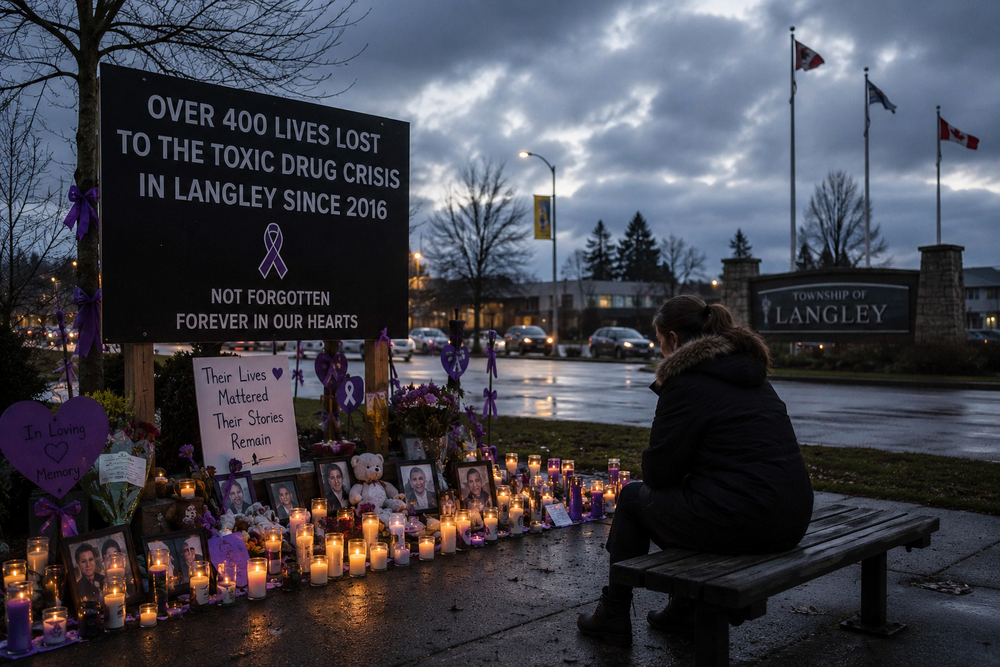
More than 400 lives lost. That number now sits at the center of one of the most emotional and politically sensitive conversations unfolding in Langley Township.

During recent council discussions, community delegates formally requested the creation of a permanent public memorial to honour local residents who have died as a result of the toxic drug crisis since 2016. Council has now referred the proposal to staff to explore possible park locations, design concepts, costs, and potential funding options.

But behind the procedural language lies something far deeper.

For many families across Langley, this crisis is no longer an abstract provincial issue or a headline from Vancouver’s Downtown Eastside. It is personal. It is local. And increasingly, it is impossible to ignore.

The proposed memorial would serve not only as a place of remembrance, but also as a public acknowledgement of the scale of loss that has touched the Township over the past decade.

Supporters say the community needs that recognition.

Advocates argue memorials create space for healing, reduce stigma, and remind people that those lost to addiction were not statistics. They were sons, daughters, parents, siblings, coworkers, classmates, and friends.

For grieving families, the request is about visibility and humanity.

Many believe communities have historically hidden addiction and overdose deaths behind silence and shame. A permanent memorial, they argue, would send a message that every life lost mattered and that the community refuses to look away from the crisis any longer.

But not everyone agrees.

Some residents question whether public parks are the appropriate location for such a memorial, while others worry it could become politically divisive or emotionally difficult for nearby neighbourhoods.

There are also broader concerns about priorities.

Critics argue governments should focus less on symbolic gestures and more on prevention, treatment access, recovery programs, mental health support, and public safety responses tied to the toxic drug crisis.

That tension reflects the larger debate unfolding across British Columbia.

The province continues facing record overdose deaths fueled by fentanyl and increasingly toxic street drugs. Communities large and small are struggling with how to balance compassion, enforcement, harm reduction, public safety, and long-term recovery solutions.

Langley is no exception.

The issue has become increasingly visible across the Fraser Valley, where municipalities are grappling with rising addiction challenges, homelessness pressures, mental health concerns, and growing public frustration over the lack of clear solutions.

Yet despite differing opinions, one reality remains undeniable.

More than 400 local lives have been lost.

And behind every number is a family forever changed.

Council’s decision to explore a memorial does not guarantee one will ultimately be built. Staff will now examine possible locations, funding models, design considerations, and community input before any final direction is determined.

But the conversation itself may already represent something significant.

For years, many communities treated the toxic drug crisis as something happening elsewhere. Now Langley is being forced to confront the reality that this tragedy exists here, too. And as the Township debates how best to remember those lost, it is also confronting a much larger question.

What responsibility does a community have to publicly acknowledge grief, addiction, and the human cost of a crisis that continues claiming lives every single week?

That answer may shape not only this memorial debate, but how Langley defines compassion, accountability, and healing in the years ahead.

Debbie Balfour | Real Estate Investing Success Coach + Podcast Host
📍 Website: www.DebbieBalfour.com
📧 Email: Debbie@DebbieBalfour.com
🔗 LinkedIn: Debbie Balfour
▶️ YouTube Channel: youtube.com/@DebbieBalfour

Join the FREE Facebook Group: Real Estate Investor Success Hub

Download your FREE 7 Proven Ways To Invest In Real Estate Without Using Your Own Cash guide.

TAGS: #Toxic Drug Crisis #Mental Health Awareness #Community Healing #Public Health #Local Government #Langley BC #Langley News #Debbie Balfour

Share this article
The link has been copied!